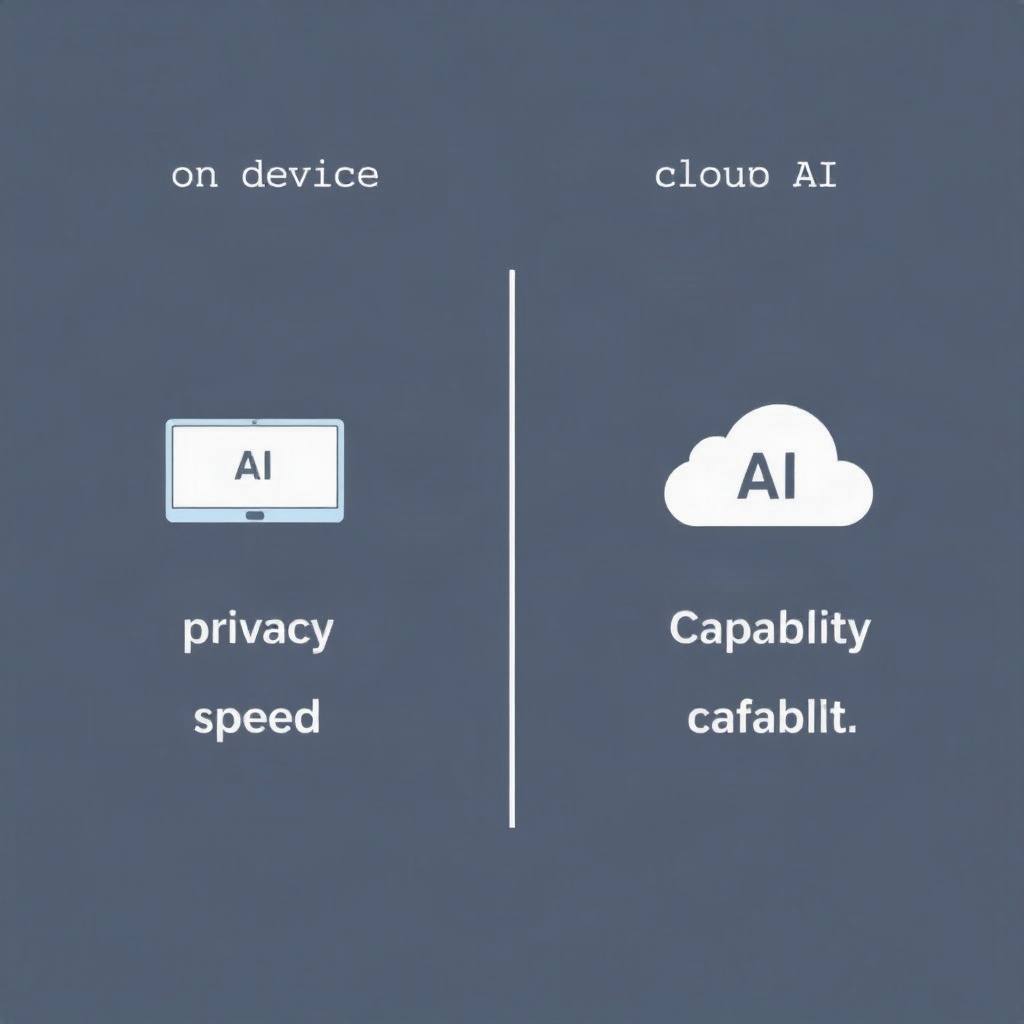
Artificial Intelligence (AI) has revolutionized the way we interact with technology, enabling machines to perform tasks that typically require human intelligence. In recent years, there has been a growing debate between on-device AI and cloud AI in terms of privacy, speed, and capability. Both approaches have their own advantages and disadvantages, and understanding the differences between them is crucial in today’s digital landscape.
Privacy Concerns with On-Device AI
On-device AI processes data locally on the device itself, which raises concerns about privacy. As the data doesn’t leave the device, users have more control over their personal information. However, there are risks of data breaches and security vulnerabilities if the device is lost or stolen.
Privacy Concerns with Cloud AI
In contrast, cloud AI processes data on remote servers, leading to potential privacy issues. Users may feel uneasy about their data being stored on third-party servers, raising questions about data security and confidentiality. Moreover, there is a risk of data misuse or unauthorized access by hackers.
Speed Comparison
When it comes to speed, on-device AI typically offers faster processing times compared to cloud AI. By running algorithms directly on the device, tasks can be completed quickly without relying on network connectivity. This is particularly beneficial for applications that require real-time decision-making.
Capability Differences
In terms of capability, cloud AI has the advantage of vast computational resources and storage capacity. This allows for more complex and resource-intensive tasks to be performed, such as training deep learning models on large datasets. On the other hand, on-device AI may be limited by the device’s processing power and memory.
Balancing Privacy and Speed
Finding the right balance between privacy and speed is crucial when choosing between on-device AI and cloud AI. Organizations must consider the sensitivity of the data being processed, the need for real-time decision-making, and compliance with data protection regulations. A hybrid approach that leverages both on-device and cloud AI may offer the best of both worlds.
Future Trends in AI
As technology continues to advance, the line between on-device AI and cloud AI is becoming increasingly blurred. Edge computing, which brings processing closer to the data source, is gaining traction as a way to improve speed and privacy. Additionally, advancements in federated learning are enabling AI models to be trained across multiple devices without sharing raw data.
Conclusion
In conclusion, the choice between on-device AI and cloud AI depends on the specific requirements of each use case. While on-device AI offers greater privacy and faster processing times, cloud AI provides scalability and computational power. As AI technology evolves, it is essential to consider the trade-offs between privacy, speed, and capability to make informed decisions.