The Gross Domestic Product (GDP) is a crucial indicator of a country’s economic performance, measuring the total value of all goods and services produced within its borders. There are three main approaches to calculating GDP: the production approach, the income approach, and the expenditure approach. In this analysis, we will focus on the expenditure approach and how it measures GDP.
The Components of the Expenditure Approach
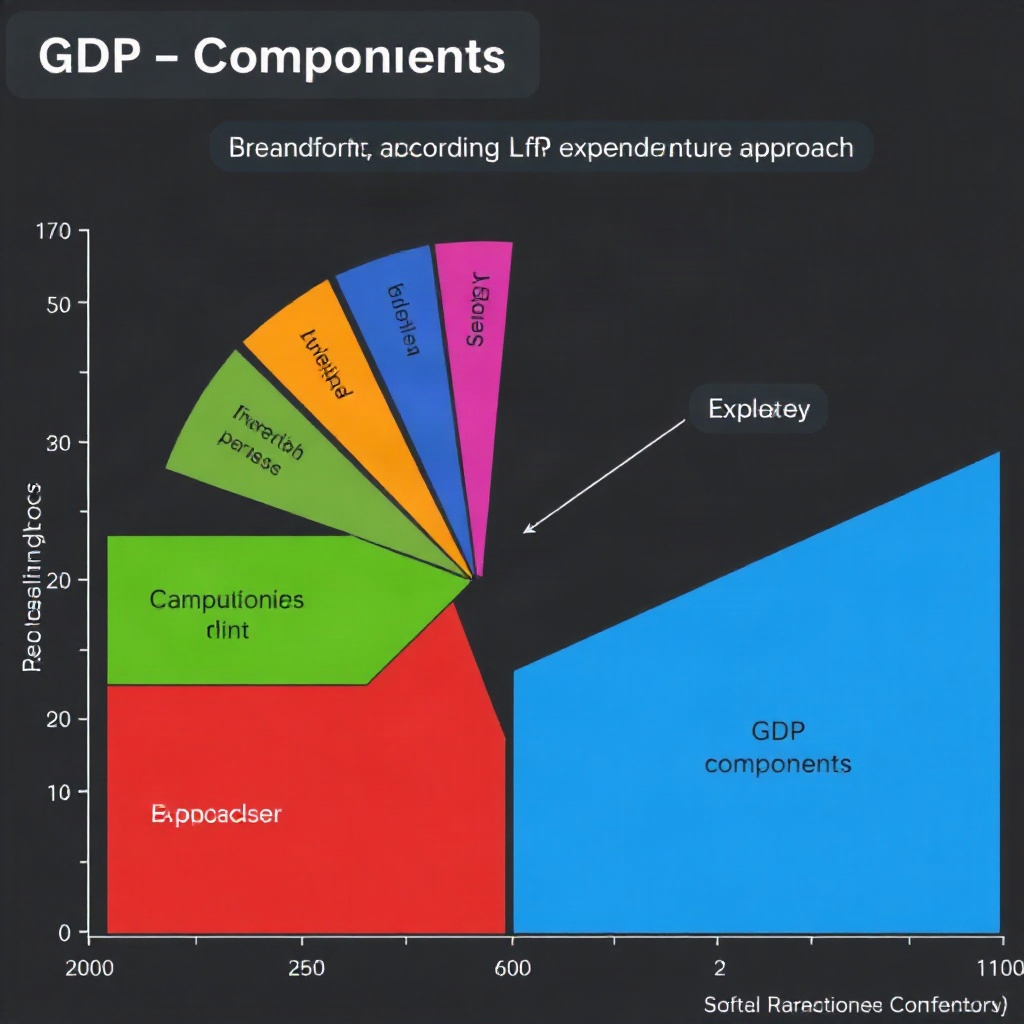
The expenditure approach breaks down GDP into four main components: consumption, investment, government spending, and net exports. Consumption refers to the total value of goods and services consumed by households. Investment includes business spending on capital goods and residential construction. Government spending encompasses all government expenditures on goods and services. Net exports represent the difference between exports and imports.
Calculating GDP Using the Expenditure Approach
To calculate GDP using the expenditure approach, we add up the total spending on each of the four components mentioned above. This formula can be represented as GDP = C + I + G + NX, where C is consumption, I is investment, G is government spending, and NX is net exports. By summing up the expenditures in each category, we arrive at the total GDP figure for a given period.
The Significance of the Expenditure Approach
The expenditure approach provides valuable insights into the economy by showing how different sectors contribute to overall economic activity. By analyzing the components of GDP, policymakers can identify trends and make informed decisions about fiscal and monetary policies. For example, an increase in consumer spending may indicate growing consumer confidence, while a decline in investment could signal economic uncertainty.
Limitations of the Expenditure Approach
While the expenditure approach is a useful tool for analyzing GDP, it does have its limitations. One criticism is that it may not capture the informal economy, where transactions are not reported to authorities. Additionally, the approach does not account for factors such as environmental degradation or income distribution, which can have significant impacts on overall well-being.
International Comparisons and Adjustments
When comparing GDP figures across countries, it is essential to consider differences in currency values and price levels. Economists often use methods like purchasing power parity (PPP) to adjust for these variations and make more accurate comparisons. By accounting for differences in the cost of living, PPP enables economists to better understand the relative economic performance of different countries.
Conclusion
In conclusion, the expenditure approach is a vital tool for measuring GDP and understanding the overall economic activity of a country. By breaking down GDP into its components and analyzing spending patterns, policymakers can gain valuable insights into the health of the economy and make informed decisions. While the approach has its limitations, it remains a key metric for assessing economic performance and guiding policy decisions.